Panic is a Signal Processing Error: The Dawn of Active Intelligence
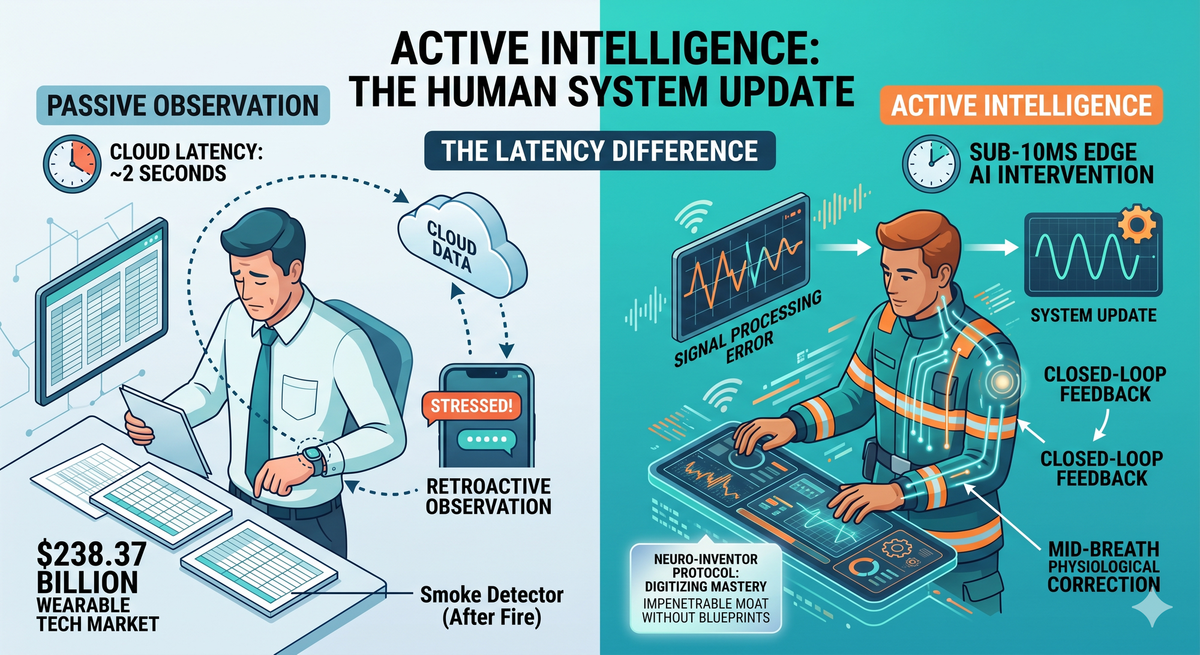
The global wearable technology market is projected to hit $238.37 Billion this year. Yet, despite the massive influx of capital, the entire industry is built on a flawed foundation: Passive Observation.
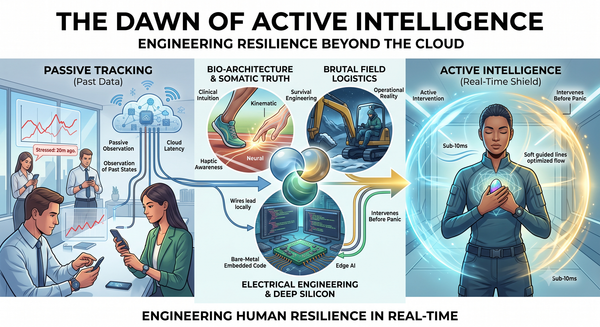
Current health tech acts like a smoke detector that only goes off after your house has already burned down. Your smart ring or watch observes your biometrics, sends them to a cloud, and tells you that you were stressed twenty minutes ago. If you are a high performer—a CEO navigating a boardroom crisis, or an industrial athlete operating heavy machinery—retroactive homework is useless.
At Axualize AI, we are permanently shifting the narrative. We are moving technology past the passive observation of what is, and founding the field of Active Intelligence: the autonomous, real-time physiological correction of what will be.
Rethinking the "Human Machine"
High performers possess a massive bias toward control. When that control fails—resulting in acute stress, burnout, or a panic attack—it feels like a humiliating betrayal of the body. Traditional solutions often frame this as a "mental weakness" to be managed through therapy or medication.
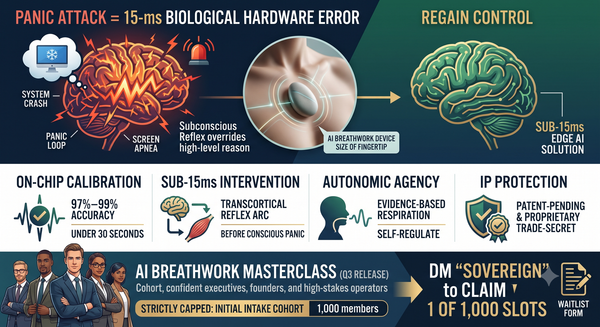
But what if panic isn't a mental weakness at all? What if it is simply a signal processing error?
If your kinematic alignment shifts or your respiratory cadence fractures, your autonomic nervous system mis-calibrates. To fix a system failure, you don't need a lecture; you need a system update. You need an intervention with zero latency.
The Neuro-Inventor Protocol: Digitizing Mastery
Most engineers see the human body as a black box. But my path to engineering didn't start in a pristine laboratory. It was forged in a collision of operational worlds. I call this synthesis the Neuro-Inventor Protocol.
Active Intelligence is built on four distinct pillars of my life:
- Somatic Intuition: Working as a clinical massage therapist (often referred to by clients as having "Miracle Hands"), I developed a high-resolution, proprioceptive understanding of exactly what a physiological correction should feel like.
- Biomechanics Logic: Utilizing frameworks from high performance personal training utilizing over 1,900+ hours of rigorous exercise and movement science research, Paul Chek, the NSCA, USATF, so many books, Sport Psychology, and my time as a Division 1 athlete... there's even more to this story:
We established the mathematical rules for human movement, core stability, and kinematic alignment. - Operational Grit: As a current National Responder for CDOT with a Class A CDL, I know that technology has to work in the mud, the rain, and under extreme physical fatigue.
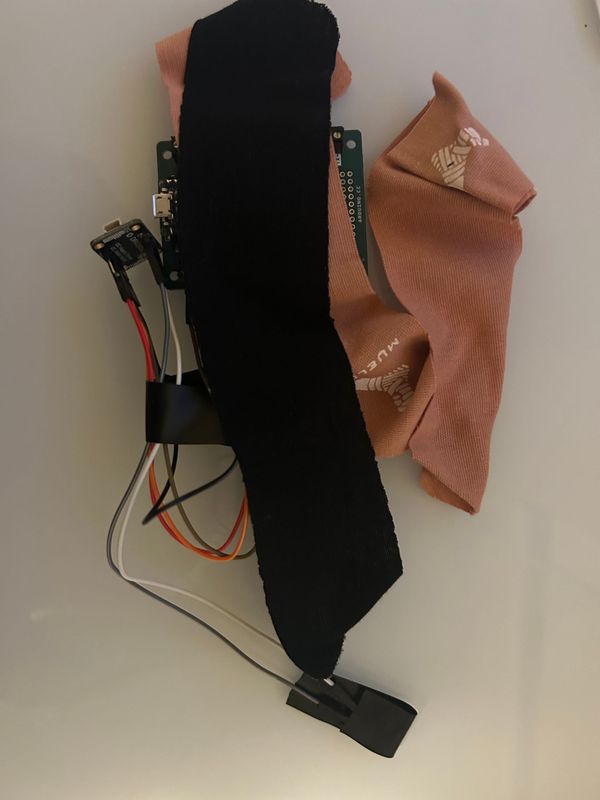
- Embedded Logic: Pursuing my MS in Electrical and Computer Engineering allows me to build the "silicon brain" required to execute these rules at the speed of thought.
We are taking the "miracle" of clinical intuition and digitizing it into math. We are scaling personal mastery into software and hardware that can be everywhere at once.
The Power of Closed-Loop Feedback
The difference between Passive and Active Intelligence comes down to one word: Latency.
To a high performer, the latency between a stress trigger and a corrective breath is the exact difference between a productive day and a panic attack. Passive tech has a 2-second cloud latency. Active Intelligence uses sub-10ms, on-device Edge AI to process your data and deliver an immediate, closed-loop haptic intervention mid-breath.
We aren't just building the nervous system for the next generation of health tech. We are giving you the tools to rewrite your own.