Taking the Guesswork Out of Breathwork: The Architecture of Our New Nervous System Classifier
Discover how the new Biometric State Classifier leverages heart rate, HRV, and respiratory rate to personalize breathwork and mitigate stress in real-time.
For decades, breathwork and mindfulness practices have relied heavily on subjective self-reporting, and still do. You feel stressed, so you try a breathing exercise. But what if the exercise you chose is actually up-regulating a nervous system that desperately needs to down-regulate?
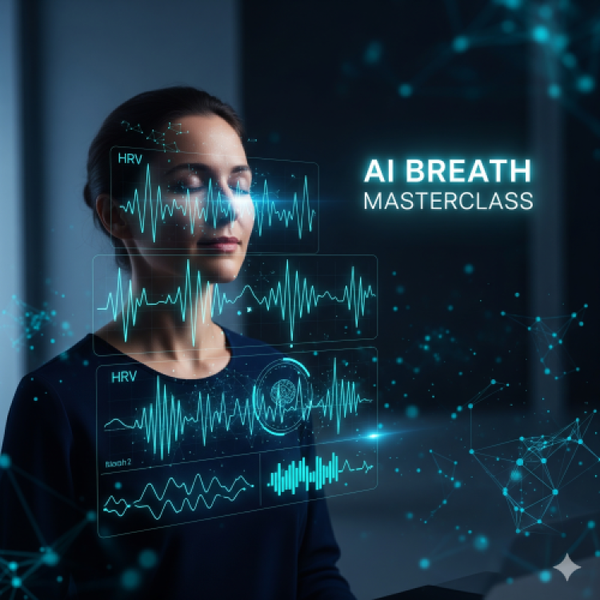
To solve this, the AI Breath Masterclass is implementing its first foundational Biometric State Classifier. By bridging the gap between raw physiological data and actionable interventions, we are turning breathwork into a precise, evidence-based science.
The Problem: Blind Interventions
Historically, generic breathwork routines act as a blunt instrument. Prescribing a "fire breath" technique to someone already locked in a sympathetic (fight-or-flight) state can exacerbate anxiety. Conversely, giving deep relaxation protocols to someone who needs focus and energy can induce lethargy.
The Masterclass solves this by adapting the intervention to the user's real-time physiology.
Shutterstock
The Solution: Evidence-Based Biomarkers
Our classifier analyzes a 60-second BiometricSnapshot consisting of three critical markers:
- Heart Rate (bpm)
- Heart Rate Variability (HRV RMSSD in ms)
- Respiratory Rate (bpm)
Instead of looking at these metrics in isolation, the classifier normalizes them against clinical bounds to map the user's state into one of three categories: SYMPATHETIC (Stress), PARASYMPATHETIC (Recovery), or BALANCED (Flow State).
The Math Behind the Baseline
To ensure accuracy, the raw biometric data must be normalized using clinical min-max bounds before being scored. Because HRV (specifically RMSSD) often presents a skewed distribution, we apply a natural logarithm transformation to linearize the data.
The normalization for HRV is calculated as:
Normalized HRV=max(0.0,min(1.0,3.4ln(HRVRMSSD)−1.6))
Once normalized, the system calculates a weighted Autonomic Score. Because higher HRV correlates with higher parasympathetic tone (rest and digest), the classifier inverts the HRV metric so that a higher final score correctly points toward a sympathetic (stress) state:
Autonomic Score=(Normalized HR⋅0.3)+(Normalized RR⋅0.3)+((1.0−Normalized HRV)⋅0.4)
If the score is >0.60, the system recognizes a Sympathetic state. If <0.40, a Parasympathetic state. Everything in between is Balanced.
What This Means for the AI Breath Masterclass
Implementing this classifier mitigates several core issues:
- Prevents Over-stimulation: The AI will automatically throttle up-regulating breathwork if it detects you are already physiologically stressed.
- Measures Efficacy: It allows users to track if a specific breathing protocol actually shifted their state from
SYMPATHETICtoPARASYMPATHETIC. - Future-Proofed for Machine Learning: While currently using a clinically-grounded heuristic routing system, the architecture is already built to ingest a PyTorch neural network. As we collect more anonymized sequence data, the model will transition from heuristic scoring to deep learning, trained on complex physiological time-series data.
By relying on biomarkers rather than guesswork, the AI Breath Masterclass ensures that every breath you take is exactly what your nervous system needs.